
- Gilgit-Baltistan, Pakistan
Hunza Valley Tours: Private Trips Through Pakistan's Karakoram
Explore royal forts up to 1,100 years old, cruise the turquoise water of Attabad Lake and drive the Karakoram Highway to the Chinese border. Our private Hunza Valley tours are planned and guided by a licensed team from Ganish, the oldest village in Hunza.
- Region: Gilgit-Baltistan, Pakistan
- Base town: Karimabad
- Altitude: about 2,500 m
- Languages: Burushaski, Wakhi, Shina, Urdu
- Best months: April–May and Sept–Oct
- Nearest airport: Gilgit, 2.5–3 hrs by road
- About Hunza
About Hunza Valley, Pakistan
Hunza Valley lies in Gilgit-Baltistan, Pakistan’s northernmost region, close to where the Karakoram, Himalaya and Hindu Kush ranges meet. The Karakoram Highway, the old Silk Road route between South Asia and China, runs the length of the valley. Snow peaks such as Rakaposhi and Ultar Sar rise directly above its villages and orchards.
For centuries Hunza was a small independent state ruled by hereditary kings called Mirs. They lived first in Altit Fort and later in Baltit Fort, and both have been carefully restored by the Aga Khan Trust for Culture. Their restoration, along with the historic village of Ganish, has earned several UNESCO Asia-Pacific Heritage Awards.
The valley has three parts, each with its own character. Central Hunza, around Karimabad, holds the forts, bazaar and the best mountain views. Upper Hunza, called Gojal, is home to Attabad Lake, the Passu Cones and Wakhi villages close to the Chinese border. Across the river lies Nagar, with glaciers you can walk beside.
Most travelers stay in Karimabad and take day trips from there. You need no climbing or trekking experience to enjoy Hunza; the main sights are reached by road and short walks.
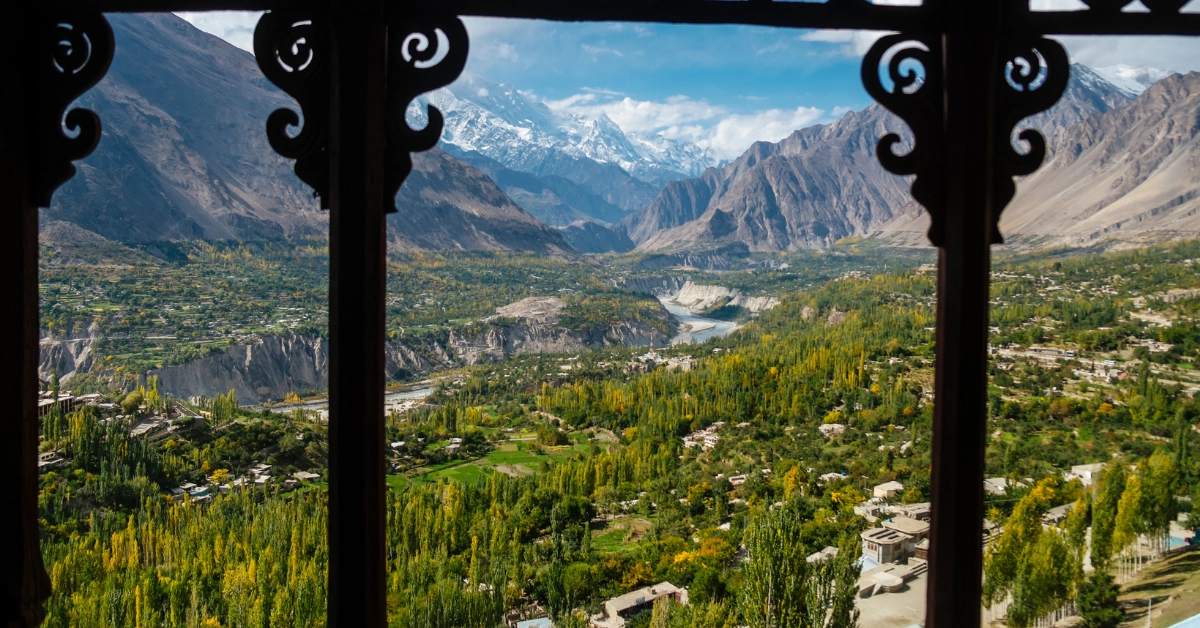
Based in Ganish, Hunza
One of the valley's oldest villages
- Tour packages
Hunza Valley tour packages
Every tour is private: your own vehicle, driver and English-speaking guide, starting on the date you choose. Pick an itinerary below, or tell us what you want to see and we will build one around it.
6 days
Quick trip
- Islamabad · Gilgit · Hunza
The Hunza essentials in under a week: Karimabad, Altit and Baltit forts, Attabad Lake and the Passu Cones.
- Altit & Baltit forts
- Attabad Lake
- Passu Cones
From
$700
per person
9 days
Popular
- Hunza · Skardu
Hunza’s forts and villages, then the cold desert and mountain lakes around Skardu.
- Hunza forts & villages
- Skardu cold desert
- Mountain lakes of Skardu
From
$1,170
per person
10 days
Bestseller
- Hunza · Fairy Meadows
The Hunza classics plus a night in the meadows facing Nanga Parbat, the world’s ninth-highest mountain.
- Karimabad & royal forts
- Night at Fairy Meadows
- Nanga Parbat views
From
$1,100
per person
10 days
Slow pace
- Hunza · Khunjerab · Skardu
A slower pace with time for Khunjerab Pass and upper Hunza.
- Khunjerab Pass
- Upper Hunza (Gojal)
- Skardu valley
From
$1,100
per person
12 days
Full circuit
- Hunza · Skardu · Fairy Meadows
The complete circuit of northern Pakistan, with spare days for weather.
- Hunza Valley
- Skardu & Deosai
- Fairy Meadows
From
$1,300
per person
- Trip length
How many days do you need in Hunza?
Plan at least four full days in the valley itself. Most international travelers combine Hunza with Skardu or Fairy Meadows on a 9 to 12 day trip.
5–6 days: Hunza only
Covers Karimabad, both forts, Ganish, Attabad Lake and Passu, with a day each way for the journey from Islamabad. Ideal if you have one week in Pakistan.
9–10 days: Hunza plus one more valley
Hunza at a relaxed pace, plus either Skardu's lakes or Fairy Meadows. The most popular length for a first visit.
12 days or more: the full circuit
Hunza, Skardu and Fairy Meadows, with spare days for weather and road delays. We recommend this length in spring and late autumn.
- Places to visit
Best places to visit in Hunza Valley
These are the sights we build our Hunza tours around, grouped by area.
Altit Fort
The oldest monument in Hunza and the first home of its Mirs, perched on a cliff above the Hunza River. Its Shikari Tower is about 1,100 years old. After restoration it won a UNESCO Asia-Pacific Award of Distinction in 2011. Walk the royal garden and the narrow lanes of Altit village below.
Baltit Fort
Over 700 years old, Baltit became the Mirs' main palace and dominates the skyline above Karimabad. Restored by the Aga Khan Trust for Culture and reopened in 1996, it is now a museum of royal life, with views across to Rakaposhi.
Ganish Historic Village
The oldest settlement on the Silk Road in Hunza, with carved wooden mosques around a village water tank. Ganish has won two UNESCO heritage awards, in 2002 and 2009. Our office is here, so our guides show you the village they grew up in.
Eagle's Nest, Duikar
A ridge-top viewpoint above Karimabad. At sunrise and sunset, Rakaposhi, Ultar Sar and Ladyfinger Peak glow pink one after another.
Karimabad Bazaar
Hunza's main street, lined with shops selling apricot oil, dried fruit, gemstones and handwoven wool. Cafés here serve local apricot cake and walnut cake with a valley view.
Attabad Lake
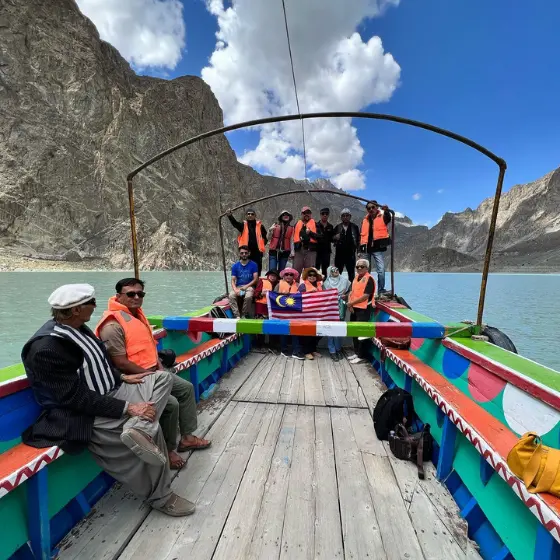
A turquoise lake formed when a landslide blocked the Hunza River in January 2010. Today you can take a boat ride or stop at the viewpoints along the highway tunnels. Under an hour's drive from Karimabad.
Passu Cones
The sawtooth spires of Tupopdan rise above Passu village. They are most striking in early morning light from the highway viewpoint.
Hussaini Suspension Bridge
A long footbridge of wooden planks and steel cables strung across the Hunza River. Crossing it is a test of nerve and a highlight of many trips.
Borith Lake and Passu Glacier
A quiet lake near Hussaini and an easy walk to a viewpoint over the glacier. A peaceful half day away from the busier stops.
Khunjerab Pass
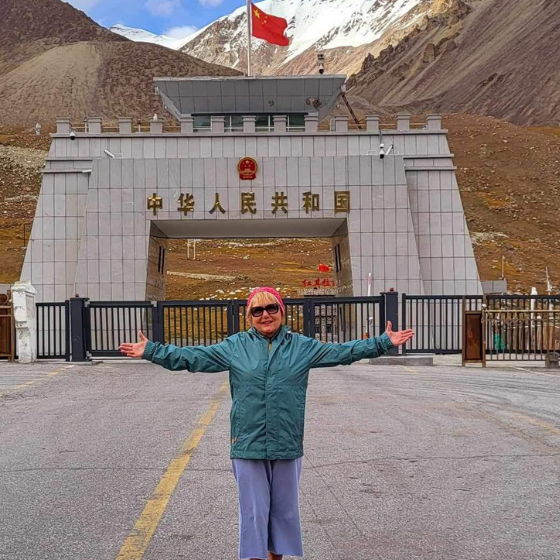
The Pakistan–China border at about 4,693 meters, the highest paved international border crossing in the world. The road climbs through Khunjerab National Park, home to marmots, ibex and the rare snow leopard. It is a full-day trip, and warm layers are needed even in summer.
Hopper Glacier
About an hour by road from Karimabad, then a short walk, brings you to the edge of a grey, slow-moving glacier with views of the surrounding peaks.
Rakaposhi View Point
A roadside stop on the Karakoram Highway with a direct view up to Rakaposhi's 7,788-meter summit.
- When to visit
Best time to visit Hunza Valley
Hunza can be visited all year, but each season suits a different kind of trip. For most travelers, the best time to visit Hunza Valley is April to May for blossom or September to October for clear skies and autumn colors.
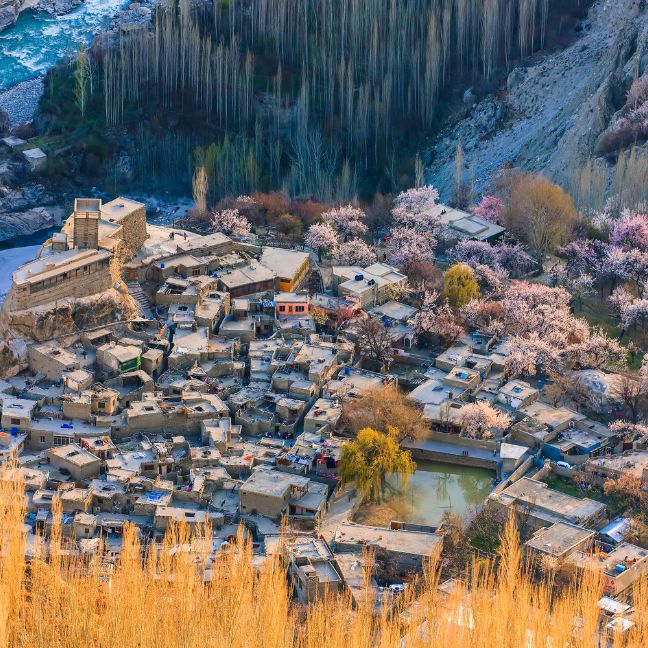
LATE MARCH – MAY
Spring
Apricot trees bloom first, followed by cherry blossom, usually in the first two weeks of April. Days are mild and nights are cold. Blossom timing shifts with each year’s weather, so allow some flexibility in your dates.
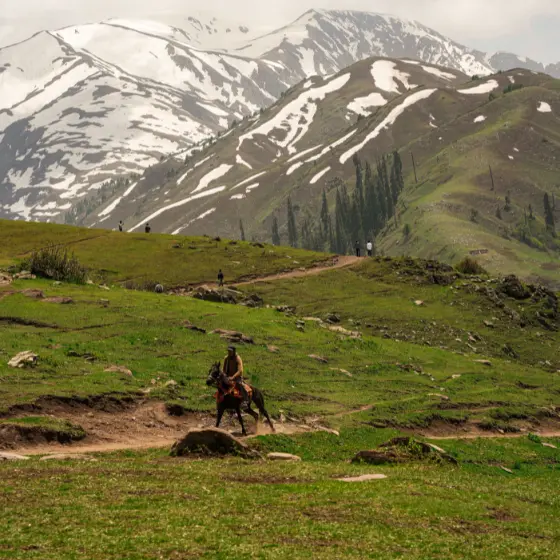
JUNE – AUGUST
Summer
Long, warm days, green orchards and the easiest conditions for hiking. July and August are the most reliable months for Khunjerab Pass. This is also peak season for domestic travelers, so book hotels early.

SEPTEMBER – NOVEMBER
Autumn
Clear, dry air brings the sharpest mountain views of the year. Poplars and orchards turn gold, orange and red, usually at their brightest in the second half of October. Our favorite season for photography.
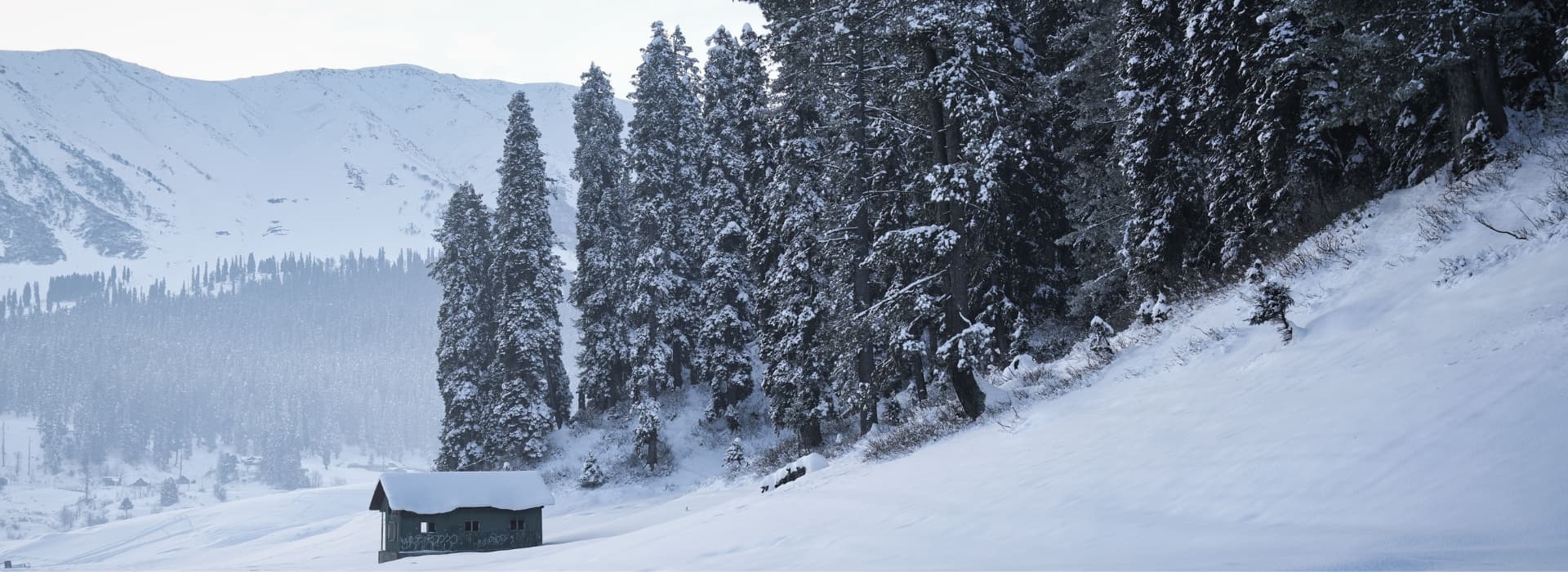
DECEMBER – FEBRUARY
Winter
Snow-covered villages, frozen lakes and very few visitors. Temperatures fall well below freezing, some hotels close, and flights to Gilgit are often cancelled, so plan spare days.
Plan by month
Hunza month by month
- Getting there
How to get to Hunza Valley
Most international trips start in Islamabad. From there you have two ways to reach Hunza, and our tours use whichever suits your dates and the season.
Fly to Gilgit, then drive
The flight from Islamabad to Gilgit takes about an hour and flies past Nanga Parbat. From Gilgit, it is a 2.5 to 3 hour drive to Karimabad. Flights only operate in clear weather and are often cancelled, so we always keep a road option ready.
Drive the Karakoram Highway
The road journey from Islamabad takes two days with an overnight stop. In summer, the route usually crosses Babusar Pass via the Naran Valley; the rest of the year, it follows the Indus along the Karakoram Highway. Slower, but the drive itself is one of the great road journeys of Asia.
Visas and permits
Most visitors need a Pakistan visa, which many nationalities can apply for online. Under normal conditions, foreign travelers do not need a separate permit for Hunza, but passports are registered at hotels and checkpoints. Rules can change, so we confirm current requirements when you book.
- Culture & food
Culture, food and festivals of Hunza
The people of Hunza are known across Pakistan for their hospitality, and for many visitors the welcome is the most memorable part of the trip.
People and languages
Most Hunza people are Burusho or Wakhi. Burushaski, spoken in central Hunza, is a language isolate, related to no other known language. Wakhi is spoken in upper Hunza and Shina in the lower valley, and Urdu is widely understood. English is common among younger people and anyone working in tourism.
Food to try
Chapshuro, a pastry filled with spiced minced meat. Diram fitti, a naturally sweet bread made from sprouted wheat. Harissa, a slow-cooked wheat and meat dish served in winter. And apricots in every form: fresh in summer, dried all year, and pressed into oil.
Festivals
Ginani, the harvest festival, is held around 21 June with music and ceremonies at Baltit Fort. Navroz, the Persian new year, is celebrated on 21 March. Ask us to time your trip around either.
Travel respectfully
Dress modestly, covering shoulders and knees. Ask before photographing people, especially women. Alcohol is not sold in shops or restaurants, and the pace of life is slow, so leave room in your days.
- Why Harappa
Why book a private Hunza tour with Harappa
5.0
48 TripAdvisor reviews · Licensed operator
01
A local team, not a reseller
We are a government-licensed operator based in Ganish, in the heart of Hunza. Our guides are from the valley.
02
Private, never shared
Your own vehicle, driver and guide. No strangers on your trip and no fixed group dates.
03
Flexible itineraries
Shorten, extend or combine any tour with Skardu, Fairy Meadows or Chitral.
04
Planned for mountain weather
We build in spare days and keep a road option for every flight, so a cancellation does not end your trip.
05
Hand-picked stays
Comfortable hotels and heritage guesthouses we know personally, chosen for their location and valley views.
- Guest reviews
What our travelers say
Recent reviews from travelers who explored Hunza and northern Pakistan with us, shown exactly as they wrote them on TripAdvisor.

 sagcSeptember 15, 2026I have been traveling for a long time and have taken tours in many countries. This tour was outstanding in many aspects. I felt I was traveling with friends and... See more not part of an organized tour. I highly recommend Harappa Tour and Travel. They are local, knowledgeable, friendly and have connections should an unexpected situation arise. I hope I can come back and explore other parts of this beautiful country with them.carl bSeptember 10, 2026Excellent communication throughout, very helpful with the visa application, the trek was superb, humbling Mountain View’s, great team, fluent English speaking guide who was superb ( thank you Sheroz), really... See more couldn’t fault them BUT bring your own sleeping mat theirs are very basic and thin!Bennett SSeptember 6, 2026Had amazing experience on this tour. It was an unbelievable experience getting to see the beautiful mountains of Pakistan. Everyone on the trek was so helpful and were some truly... See more amazing people.
- Happiness20334759159June 24, 2026Our group of 10 recently completed a memorable journey through Hunza, Gilgit-Baltistan, Fairy Meadows and the surrounding mountain regions with Harappa Tour & Travel.
The landscapes were breathtaking, from... See more the Karakoram Highway and Hunza Valley to the spectacular views of Nanga Parbat and the surrounding mountain ranges. Pakistan's natural beauty exceeded our expectations.
A special thanks to our guide, Kamal, and the Harappa team for their excellent coordination throughout the trip. Road conditions and weather in the northern areas can change quickly, but the team kept us updated and managed the itinerary professionally while always prioritizing safety.
The airport pickup, transportation, accommodations, and daily logistics were well organized. We especially appreciated the local knowledge shared by the guide, which helped us better understand the culture, history, and people of the region.
Northern Pakistan is one of the most beautiful destinations we have visited, and we would not hesitate to recommend Harappa Tour & Travel to anyone planning a trip to this remarkable part of the world.
Thank you for making this a truly unforgettable experience.Ching Yi WDecember 6, 2025My recent tour in Hunza was wonderful—a perfect blend of adventure, culture, and relaxation. The tour service was excellent, marked by professionalism, efficiency, and genuine care throughout the journey. My... See more guide went above and beyond to ensure everything ran smoothly, making the experience not only stress-free but deeply enriching. It was the kind of journey that leaves you refreshed, inspired, and full of stories to share long after it ends.Francisca PNovember 15, 2025I feel very grateful to have visited the north of Pakistan with the Harappa guides, in a tailored trip of 2 weeks. Starting this journey in Skardu, we trekked up... See more to Marsur rock, with stunning valley views. Moving through the unique Gilgit Baltistan region, we trekked to Fairy Meadows to be surrounded by idyllic nature and fantastic views of Nanga Parbat. From here we travelled to the beautiful Hunza valley, that presented us with Autumn colours, blue glacial rivers and imposing mountains dressed in white. Passu cones, the village of Ganish and the breathtaking views from Karimabad were highlights for me. From here we embarked on a long Jeep ride to reach the Kalash valleys, where after a couple of days driving through beautiful valleys we had the opportunity to connect with the Kalash community and its beautiful people. Including attending a wedding and dancing through the nigh! The trip ended by visiting the bustling city of Peshawar and its colourful markets.
I can't thank our local guides Kumail, Fida, Abide and Saleem enough, who were always listening to our needs, adjusting the trip if needed based on our requests, showing flexibility and doing so with a smile. Their knowledge of the region is invaluable. Most importantly, they made me feel part of their family and integrated us in their beautiful community with open arms. Until next time,
Francisca - 楡暄 黄November 13, 2025Travelling in Pakistan with Harappa was truly an amazing experience! This was my first visit to Pakistan and it was just beyond imagination and words.
The views, the... See more people, the food and the culture were all terrific! Every spot we visited was so breathtaking and meaningful. Our tour guides, Kumail and Sultan were warm, caring and absolutely wonderful. They took great care of every member in the group and were always attentive toward small things. I enjoyed their sharing about local life in Hunza and also love their informative introduction to Pakistani culture and history.
The drive along the Karakoram Highway was another adventure in itself, but with our skilled and experienced driver, Afdab, we felt safe and at ease throughout the journey.
I am truly grateful for all these arrangements made by Saleem. It was such a joy to travel in Pakistan with Harappa.
For anyone who wants to take beautiful photos, immerse themselves in nature and discover the authentic spirit of Pakistan, choose Harappa! They'll make your journey unforgettable.ushanluvNovember 13, 2025Travelling in Pakistan with Harappa was truly an amazing experience! This was my first visit to Pakistan and it was just beyond imagination and words.
The views, the... See more people, the food and the culture were all terrific! Every spot we visited was so breathtaking and meaningful. Our tour guides, Kumail and Sultan were warm, caring and absolutely wonderful. They took great care of every member in the group and were always attentive toward small things. I enjoyed their sharing about local life in Hunza and also love their informative introduction to Pakistani culture and history.
The drive along the Karakoram Highway was another adventure in itself, but with our skilled and experienced driver, Afdab, we felt safe and at ease throughout the journey.
I am truly grateful for all these arrangements made by Saleem. It was such a joy to travel in Pakistan with Harappa.
For anyone who wants to take beautiful photos, immerse themselves in nature and discover the authentic spirit of Pakistan, choose Harappa! They'll make your journey unforgettable.bren307August 29, 2025End to end perfect organization of activities with guide and driver. Weather conditions required some planning changes. Sign of a brilliant tour company was their ability to adapt swiftly and... See more efficiently. The driver (Sajar) was exceptionally safe in tough conditions and the guide (Kamal) was young, experienced, fun, interesting, with fabulous insights of Himalaya, Karakoram, Hindu Kush and Gilgit-Baltistan and great, great company. The booking through Sameer was perfectly adapted to my wishes with recommendations that made sense for the end of Monsoon season. I will be returning soon for trekking experience and will use Harappa Travel.


Travelled with Harappa? We'd love to hear about your trip.
- Start planning
Plan your Hunza Valley tour
Tell us when you want to travel and what interests you. Our team in Hunza will reply within 24 hours with a suggested itinerary and price, with no obligation to book.
- WhatsApp +92 311 8812 885
- 8:00 AM – 11:00 PM PKT, 7 days
- Kalan Ganish, Hunza Valley 15700, Gilgit-Baltistan
Get your free itinerary
Fields marked * are required.
Prefer to chat? Message us on WhatsApp at +92 311 8812 885, 8 AM to 11 PM Pakistan time, seven days a week.
- Before you travel
Hunza Valley travel FAQ
Safety, permits, altitude and timing: the questions travelers ask us most before a Hunza trip.
Still have a question?
Message our team on WhatsApp, 8:00 AM – 11:00 PM Pakistan time.
Is Hunza Valley safe for foreign tourists?
Hunza has a strong record as one of the safest and most welcoming regions of Pakistan, and it attracts international travelers every year. As for any trip, check your government’s latest travel advice before you book.
Do foreigners need a permit to visit Hunza?
Under normal conditions, no separate permit is needed for Hunza; you need a valid Pakistan visa, and your passport is registered at hotels and checkpoints. Rules can change, so we confirm current requirements when you book.
How many days do I need in Hunza?
Plan at least four full days in the valley, or five to six days including travel from Islamabad. A 9 to 12 day trip lets you add Skardu or Fairy Meadows.
When is cherry blossom season in Hunza?
Cherry blossom usually peaks in the first two weeks of April, with apricot blossom slightly earlier. Exact dates change each year with the weather.
Can I visit Khunjerab Pass on a Hunza tour?
Yes, as a full-day trip from Karimabad. Access depends on snow, so the visit is most reliable from late spring to autumn, especially in July and August.
How much does a Hunza Valley tour cost?
Our private Hunza Valley tour packages start from US$700 per person for 6 days. The price depends on group size, season and hotel standard, and we send a full quote within 24 hours.
Will the altitude affect me?
Karimabad is at about 2,500 meters, which most healthy travelers manage without problems. Khunjerab Pass is much higher, at about 4,693 meters, so the time spent at the top is kept short.
How do I get from Islamabad to Hunza?
Either fly to Gilgit in about an hour and drive 2.5 to 3 hours to Karimabad, or drive the whole way over two days. Our tours include all transport.
Licensed & registered in Pakistan
Government-licensed tour operator, PATO member and TripAdvisor-rated 5.0.


A licensed tour operator from Ganish, Hunza. We plan, drive and guide private and small-group journeys across Pakistan — from K2 Base Camp to the Kalash valleys.
Destinations
Get in Touch
+92 311 8812 885
harappa.tnt@gmail.com
Office
Kalan Ganish, Hunza Valley 15700, Gilgit-Baltistan
Open 7 days
8:00 AM – 11:00 PM (PKT)
© 2026 Harappa Tour & Travel · Licensed tour operator, Hunza Valley, Pakistan